AI STUDY METHOD PRESENTS
REVISION ARCADE
EVERY SUBJECT · EVERY LEVEL · 22 GAMES · COLLECT COINS
▶ ENTER FREE →
◆ INSERT COIN ◆
GCSE Physics Revision

Electricity

Current, voltage and resistance, series and parallel circuits, mains electricity and power.

Quick check · one tap
What happens to the total resistance when you add another resistor in parallel?

Electricity is a core part of GCSE Physics. Revise the key concepts and common mistakes below, then lock them in with the free games.

Key concepts

CurrentRate of flow of charge, measured in amperes.
Potential differenceEnergy transferred per unit charge, measured in volts.
ResistanceOpposition to current; V = IR (Ohm's law).
Series circuitsOne path; current is the same throughout.
Parallel circuitsMultiple paths; pd is the same across each branch.
Electrical powerP = VI; the rate of energy transfer.
PowerP = V I = I^2 R = V^2 / R
EnergyE = P t = V I t
Series add RR = R1 + R2
Parallel add 1/R1/R = 1/R1 + 1/R2
ChargeQ = I t
Joule = watt second1 J = 1 W s
Ohmic conductorStraight line through origin
Filament bulbCurve - R rises with T

What your exam board covers

Where Electricity sits in each exam board's specification. Tap a board to see what it lists.

AQAElectricitySpec 8463
  • Current, potential difference and resistance
  • Series and parallel circuits
  • Domestic uses and safety
  • Energy transfers
  • Static electricity (physics only)

Source: AQA GCSE Physics (8463) specification — Subject content, accessed 23 June 2026.

CCEA2.3 ElectricitySpec 1210

Part of: Unit 2 — Waves, light, electricity, magnetism, electromagnetism and space physics

Source: CCEA GCSE Physics (2017) specification, accessed 9 July 2026.

EdexcelTopic 10 — Electricity and circuitsSpec 1PH0

Part of: Paper 2 topics

Source: Pearson Edexcel GCSE (9–1) Physics (1PH0) specification, accessed 23 June 2026.

EdexcelTopic 11 — Static electricitySpec 1PH0

Part of: Paper 2 topics

Source: Pearson Edexcel GCSE (9–1) Physics (1PH0) specification, accessed 23 June 2026.

Eduqas/WJECElectricitySpec C420P (QAN 601/8624/0)
  • Current, potential difference and resistance
  • Series and parallel circuits
  • Static electricity, forces and electric fields
  • Domestic uses and safety

Source: Eduqas/WJEC GCSE Physics specification (from 2016), accessed 24 June 2026.

OCRP3 ElectricitySpec J249
  • P3.1 Static and charge
  • P3.2 Simple circuits

Source: OCR GCSE (9–1) Physics (Gateway A) (J249) specification, accessed 23 June 2026.

Cambridge IGCSEElectricity and magnetismSpec 0625
  • Simple phenomena of magnetism
  • Electrical quantities
  • Electric circuits
  • Electrical safety
  • Electromagnetic effects

Source: Cambridge IGCSE Physics (0625) syllabus, accessed 23 June 2026.

Edexcel IGCSEElectricitySpec 4PH1
  • (a) Units
  • (b) Mains electricity
  • (c) Energy and voltage in circuits
  • (d) Electric charge

Source: Pearson Edexcel International GCSE Physics (4PH1) specification, accessed 23 June 2026.

Common mistakes to avoid

Questions where students often pick the tempting wrong answer — make sure you know the right one:

What happens to the total resistance when you add another resistor in parallel?✗ Adding any resistor always increases the total resistance.   ✓ Total resistance decreases — there are more paths for current to flow.
What happens to the current as it goes around a series circuit?✗ Current gets used up by each component as it flows around the circuit.   ✓ It stays the same at every point — current is conserved.
What does voltage (potential difference) across a component represent?✗ Voltage is the 'amount of electricity' flowing through the wire.   ✓ The energy transferred per unit charge passing through that component.
The I-V graph of a filament lamp is a curve that flattens out. Why?✗ The diode blocks reverse current   ✓ Its resistance increases as it heats up
Which instrument measures current, and how is it connected?✗ Voltmeter, in parallel   ✓ Ammeter, in series

Practise Electricity — free games

Test yourself with these quick revision games for this topic:
See all 22 games in the Revision Arcade →

More GCSE Physics topics

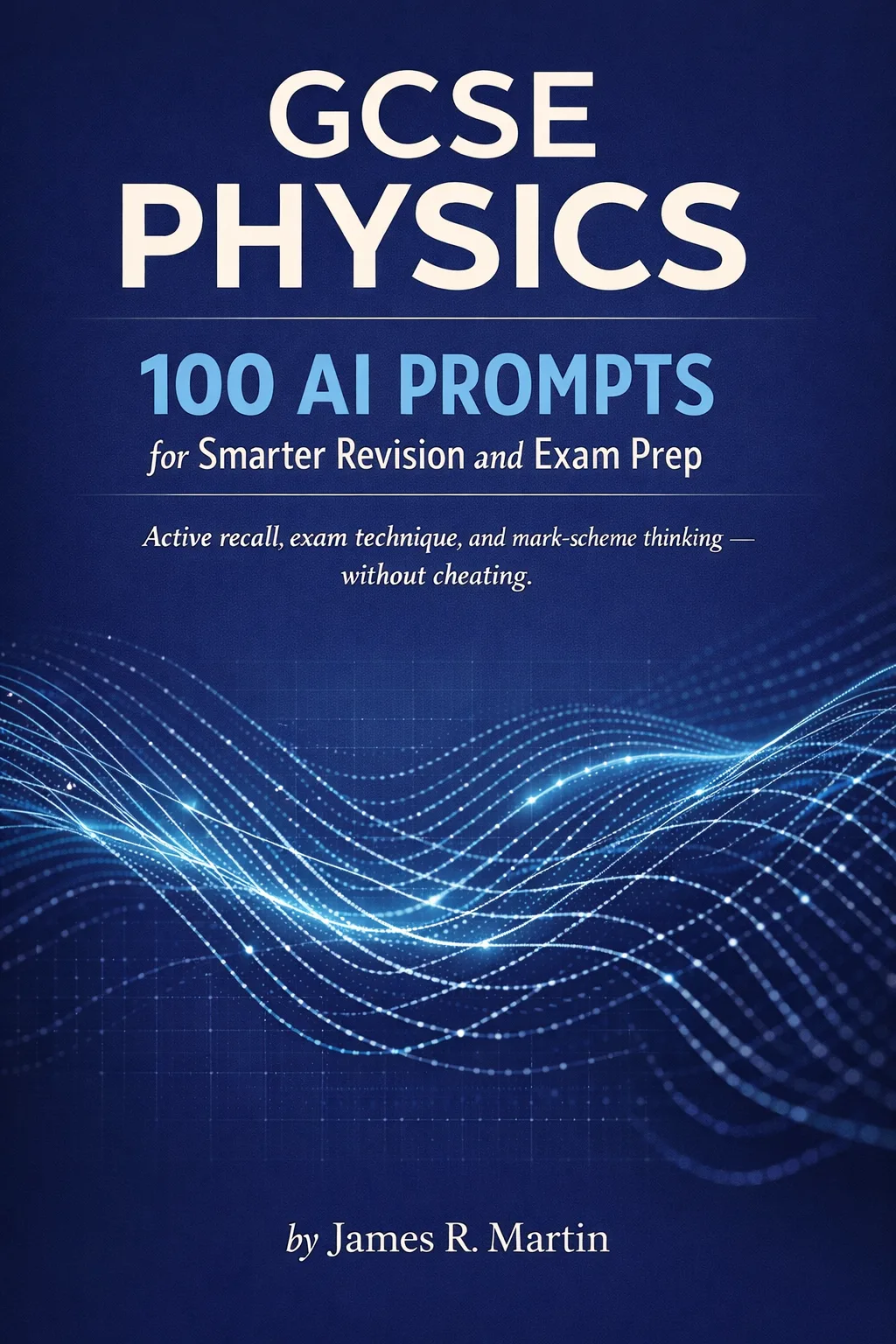
Cover of 100 AI Prompts for GCSE Physics
Free · PDF
100 AI Prompts for GCSE Physics

Print-and-paste prompts built around the Velvet Method, so ChatGPT tests your thinking instead of doing it for you.

Download free PDF →All 91 free prompt books

← All revision guides

Want to revise every topic this smart?

The Velvet Method shows you how to use AI to revise any subject, in six steps.

See the Velvet Method →