AI STUDY METHOD PRESENTS
REVISION ARCADE
EVERY SUBJECT · EVERY LEVEL · 22 GAMES · COLLECT COINS
▶ ENTER FREE →
◆ INSERT COIN ◆
GCSE German Revision

Grammar & Key Verbs

High-frequency verbs, tenses and core grammar you need across every topic.

Quick check · one tap
How many genders do German nouns have?

Grammar & Key Verbs is a core part of GCSE German. Revise the key concepts and common mistakes below, then lock them in with the free games.

Key concepts

Noun gendersEvery German noun is masculine (der), feminine (die) or neuter (das), and all nouns start with a capital letter.
CasesNominative for the subject, accusative for the direct object, dative for the indirect object; articles change, e.g. masculine der → den → dem.
sein and habenThe two key irregular verbs: ich bin (I am), ich habe (I have); both are also used to form the perfect tense.
Present tenseRemove -en from the infinitive and add endings: ich spiele, du spielst, er spielt, wir spielen, ihr spielt, sie spielen.
Modal verbskönnen, müssen, dürfen, wollen, sollen and mögen send a second verb to the end as an infinitive: Ich muss heute arbeiten.
Perfect tensehaben or sein plus a past participle at the end: Ich habe Fußball gespielt; Ich bin nach Berlin gefahren.
Imperfect tenseThe simple past, common in writing; learn key forms such as war (was), hatte (had) and es gab (there was/were).
Future tenseA present-tense form of werden plus an infinitive at the end: Ich werde Spanisch lernen (I will learn Spanish).
Verb second ruleIn a main-clause statement the verb is the second idea, so a time phrase first causes inversion: Am Montag spiele ich Tennis.
Verb to the endAfter weil, dass, wenn or ob, the verb goes to the end of its clause: Ich lerne Deutsch, weil es Spaß macht.
Learn Grammar & Key Verbs step by step

Free interactive mini-lessons: short screens, worked examples and quick checks. Pick your exam board to open its course map, then tap L on this topic:

Common mistakes to avoid

Questions where students often pick the tempting wrong answer — make sure you know the right one:

How many genders do German nouns have?✗ Two, like French and Spanish.   ✓ Three — masculine, feminine and neuter (der, die, das).
Is German word order the same as English?✗ Yes, exactly like English.   ✓ No — the verb is usually second in main clauses and last in subordinate clauses.

Practise Grammar & Key Verbs — free games

Test yourself with these quick revision games for this topic:

See all 22 games in the Revision Arcade →
More GCSE German topics

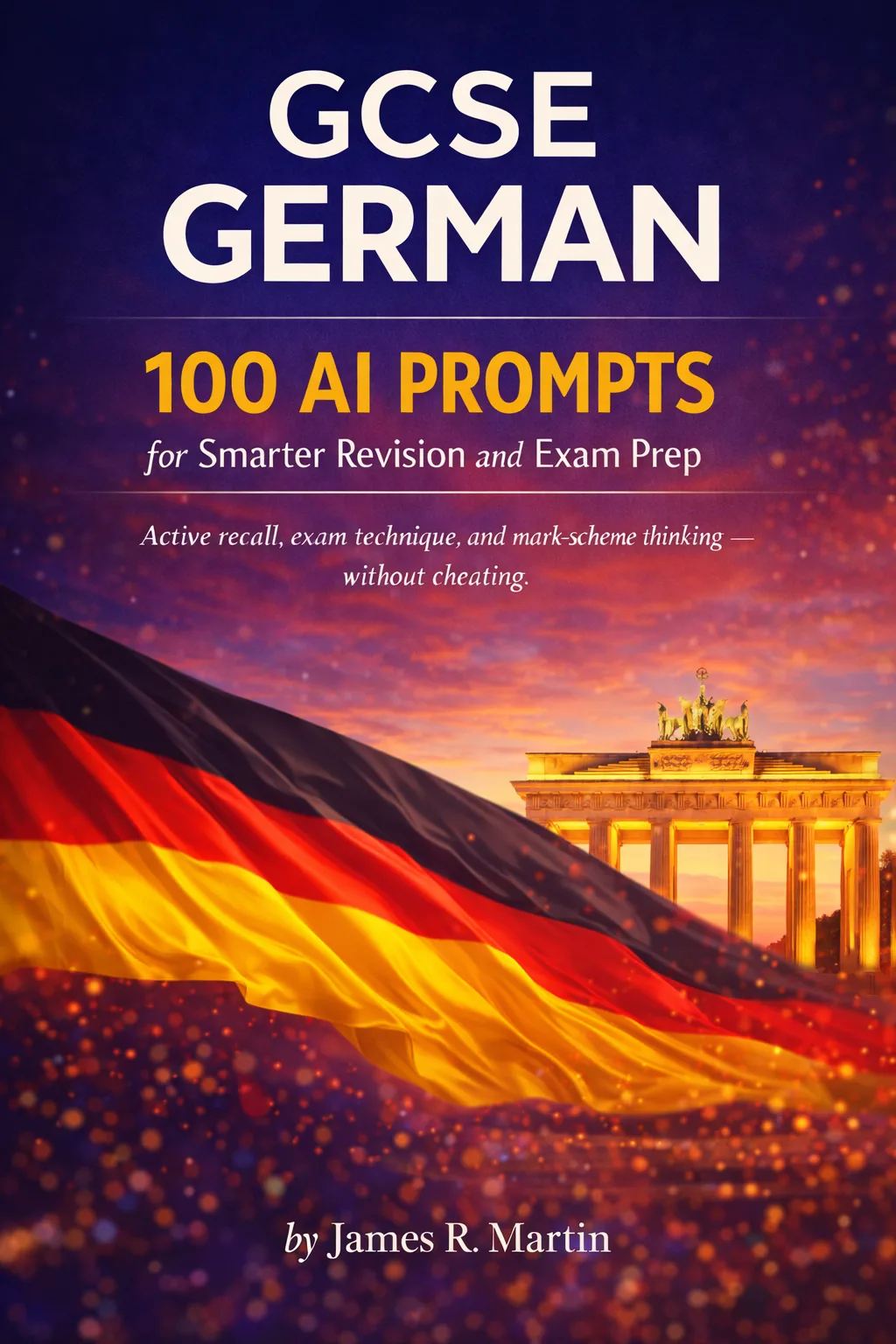
Cover of 100 AI Prompts for GCSE German
Free · PDF
100 AI Prompts for GCSE German

Print-and-paste prompts built around the Velvet Method, so ChatGPT tests your thinking instead of doing it for you.

Download free PDF →All 91 free prompt books

← All revision guides

Want to revise every topic this smart?

The Velvet Method shows you how to use AI to revise any subject, in six steps.

See the Velvet Method →