AI STUDY METHOD PRESENTS
REVISION ARCADE
EVERY SUBJECT · EVERY LEVEL · 22 GAMES · COLLECT COINS
▶ ENTER FREE →
◆ INSERT COIN ◆
GCSE Computer Science Revision

Programming

Programming constructs, data types, subroutines, databases and SQL, and writing robust, well-tested programs.

Quick check · one tap
What is a primary key?

Programming is a core part of GCSE Computer Science. Revise the key concepts and common mistakes below, then lock them in with the free games.

Key concepts

VariableA named store whose value can change.
ConstantA named store whose value never changes.
IntegerA whole number with no fractional part.
FloatA number with a decimal point, e.g. 3.14.
BooleanA value that is True or False.
StringA sequence of characters, e.g. 'hello'.
FOR loopRepeats a block a fixed number of times.
WHILE loopRepeats while a condition is True.
IF/ELSERuns one block or another based on a test.
FunctionA named block of code that returns a value.
ParameterAn input passed to a function.
Return valueThe value a function gives back to the caller.
ProcedureA named block of code that does not return a value.
Local scopeA variable only visible inside its function.

What your exam board covers

Where Programming sits in each exam board's specification. Tap a board to see what it lists.

AQAProgrammingSpec 8525
  • Data types and programming concepts
  • Programming techniques (sequence, selection, iteration)
  • Subroutines, structured programming and IDEs
  • Boolean operators and string handling

Source: AQA GCSE Computer Science (8525) specification — Subject content, accessed 23 June 2026.

EdexcelProblem solving with programmingSpec 1CP2
  • Develop code
  • Constructs
  • Data types and structures
  • Input/output
  • Operators
  • Subprograms

Source: Pearson Edexcel GCSE Computer Science (1CP2) specification, accessed 23 June 2026.

EdexcelProgramming languagesSpec 1CP2

Part of: Computers

Source: Pearson Edexcel GCSE Computer Science (1CP2) specification, accessed 23 June 2026.

OCRProgramming fundamentalsSpec J277

Part of: Component 2 — Computational thinking, algorithms and programming

Source: OCR GCSE (9–1) Computer Science (J277) specification, accessed 23 June 2026.

OCRProgramming languages and IDEsSpec J277

Part of: Component 2 — Computational thinking, algorithms and programming

Source: OCR GCSE (9–1) Computer Science (J277) specification, accessed 23 June 2026.

Cambridge IGCSEProgrammingSpec 0478
  • Programming concepts
  • Arrays
  • File handling

Source: Cambridge IGCSE Computer Science (0478) syllabus, accessed 23 June 2026.

Learn Programming step by step

Free interactive mini-lessons: short screens, worked examples and quick checks. Pick your exam board:

Common mistakes to avoid

Questions where students often pick the tempting wrong answer — make sure you know the right one:

What is a primary key?✗ A field that can have duplicate values.   ✓ A field that uniquely identifies each record in a table.
What does SQL do?✗ Designs the physical hardware.   ✓ Lets you query and manage data in a relational database.

Practise Programming — free games

Test yourself with these quick revision games for this topic:

See all 22 games in the Revision Arcade →
More GCSE Computer Science topics

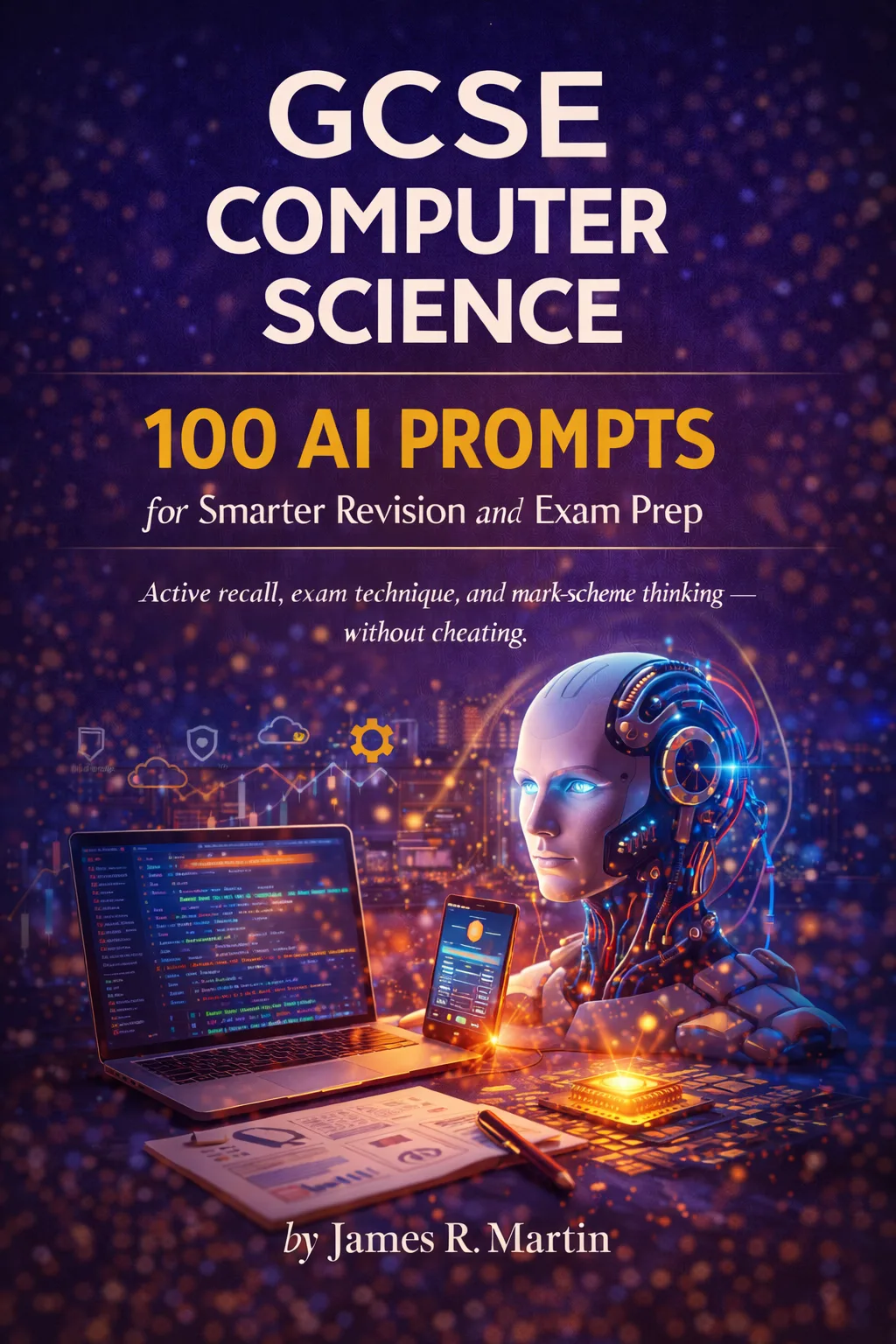
Cover of 100 AI Prompts for GCSE Computer Science
Free · PDF
100 AI Prompts for GCSE Computer Science

Print-and-paste prompts built around the Velvet Method, so ChatGPT tests your thinking instead of doing it for you.

Download free PDF →All 91 free prompt books

← All revision guides

Want to revise every topic this smart?

The Velvet Method shows you how to use AI to revise any subject, in six steps.

See the Velvet Method →