AI STUDY METHOD PRESENTS
REVISION ARCADE
EVERY SUBJECT · EVERY LEVEL · 22 GAMES · COLLECT COINS
▶ ENTER FREE →
◆ INSERT COIN ◆
IB Maths Revision

Number & Algebra

Sequences and series, exponents and logarithms, the binomial theorem and complex numbers.

Quick check · one tap
Does multiplying always make a number bigger?

Number & Algebra is a core part of IB Maths. Revise the key concepts and common mistakes below, then lock them in with the free games.

Key concepts

Indices lawsRules for powers, e.g. xᵃ × xᵇ = xᵃ⁺ᵇ.
Polar formz = r(cos θ + i sin θ).
Exponential formz = r e^(iθ), via Euler's formula.
De Moivre(cos θ + i sin θ)^n = cos(nθ) + i sin(nθ).
Multiplicationz1 z2 = r1 r2 e^(i(θ1+θ2)).
Divisionz1 / z2 = (r1/r2) e^(i(θ1-θ2)).
Modulus times|z1 z2| = |z1| × |z2|.
Root of unityComplex z with z^n = 1.
Primitive rootω = e^(2πi/n), generates all n roots.
Learn Number & Algebra step by step

Free interactive mini-lessons: short screens, worked examples and quick checks. Pick your exam board to open its course map, then tap L on this topic:

Common mistakes to avoid

Questions where students often pick the tempting wrong answer — make sure you know the right one:

Does multiplying always make a number bigger?✗ Yes, multiplication always increases a number.   ✓ No — multiplying by a number between 0 and 1 makes it smaller.
How do you decide the order of operations?✗ Always strictly left to right.   ✓ Brackets, indices, then ×/÷, then +/− (BIDMAS).

Practise Number & Algebra — free games

Test yourself with these quick revision games for this topic:

See all 22 games in the Revision Arcade →
More IB Maths topics

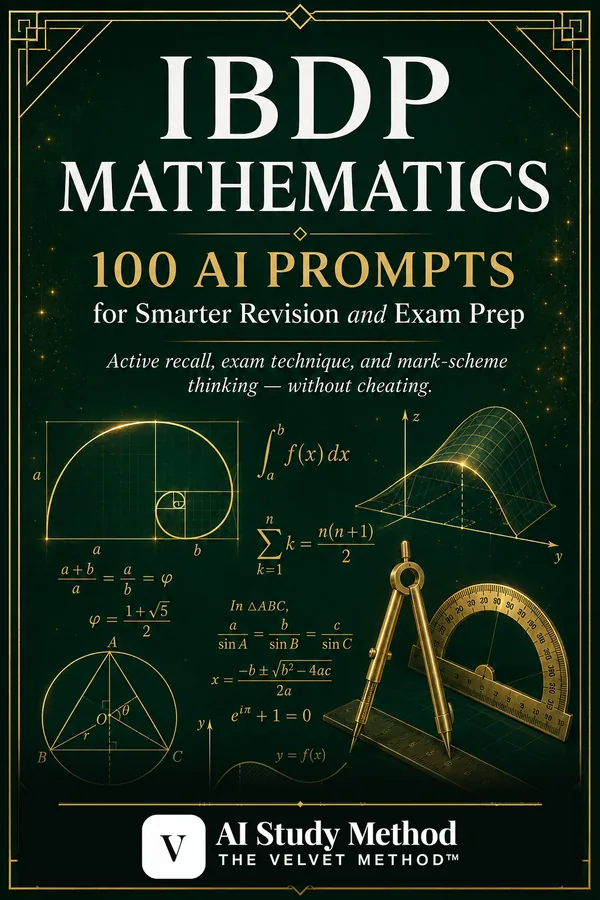
Cover of 100 AI Prompts for IB Mathematics
Free · PDF
100 AI Prompts for IB Mathematics

Print-and-paste prompts built around the Velvet Method, so ChatGPT tests your thinking instead of doing it for you.

Download free PDF →All 91 free prompt books

← All revision guides

Want to revise every topic this smart?

The Velvet Method shows you how to use AI to revise any subject, in six steps.

See the Velvet Method →